MSG hidden in Packaged Foods: Why I don’t buy 90% of the ‘food’ at WholeFoods
What’s Wrong with WholeFoods?
It’s not easy to be the messenger of bad news when so many people love and revere WholeFoods. Well, I love them too…and there are things that I do buy there which I will mention later. But as the title to this article states, I do not buy 90% of their food. And today I’m going to tell you why.
All information in this article is for educational purposes only.
It is not for the diagnosis, treatment, prescription or cure of any disease or health condition.
Now of course WholeFoods does sell meat and various processed foods…so right away, I wouldn’t buy those. But I know a lot of you do, and you mistakenly believe that if you buy food at WholeFoods, that it’s organic, non-GMO and chemical-free. That is simply NOT true. While some foods at WholeFoods are certified organic, most are not. And even the organic foods contain suspicious additives.
I’m going to show you what to look for and what to avoid.
If I only I had a dollar for every time someone said to me, ‘I don’t eat MSG because I buy everything from WholeFoods’ or ‘I only buy organic because I shop at WholeFoods,’ well, I would already be retired by now! It amazes me how strongly people are influenced by a good logo, ‘clean and green’ marketing and nice lighting and music in a store. Did I mention how many clients I’ve helped recover from migraines, insomnia, itchy rashes, anxiety, digestive disorders, hot flashes (in men and women), dizzy spells, vertigo, adult acne, puffiness and chronic inflammation by going through a detailed list of what they eat from WholeFoods and getting the offending foods out of their diet? Often times people are resistant to believe me. They can’t imagine that their organic Annie crackers are causing their troubles. Or their Earth Balance or Smart Balance ‘Butter’. They sometimes yell at me and call me a liar. Well, I am taking the crack away from the junkie…so I know I will meet resistance (yes, these chemical additives are chemically addictive). Over time, if they do change, they come to accept what I have told them and when they take the suspicious food out, their skin clears, they sleep for the first time in years, they no longer feel depressed, their migraines are gone forever…and then the Thank You emails roll in. I’ve been teaching this stuff for 6 years, and I know what I am talking about. If you partner or child is exceptionally irritable and suffers from any of the symptoms above, your salad from the salad bar at WholeFoods could be causing the problem.
If you want to have good health, you have to check all food labels and you have to be responsible for what you put in your mouth.
Monosodium Glutamate (MSG), Ribonucleotide, Disodium Inosinate, and Disodium Guanylate are flavor enhancers which add a salty, savory taste to foods. They overstimulate the taste in food, making a bland food taste exceptionally good. They also overstimulate the brain, and are known as “excito-toxins”. They can be listed either by the food additive name or by the food additive number (sometimes called ‘E numbers’): 621, 635, 631 and 627.
Legally, these food additives can also be ‘hidden’ in terms such as ‘spices,’ ‘yeast extract,’ ‘hydrolyzed vegetable protein,’ ‘natural flavors’ and ‘flavoring.’
As an interesting side note, I checked the WholeFoods website before writing this post and I found a very funny article titled, “Myths and Misconceptions: MSG.” In the article, a WholeFoods representative discusses the ‘Myth: There’s Hidden MSG lurking in our aisles.’ He states, “We draw a clear line between natural glutamate-containing foods, which we allow, and highly concentrated MSG, which we don’t..” I actually laughed out loud when I read that, because I see Monosodium Glutamate in various forms in the salad bar ingredients in WholeFoods ALL THE TIME! Right there for the world to see! Well, I am usually the annoying one who is reading every label and holding up the salad bar line, and maybe even sneaking out my camera for a photo! (By the way, an example of a ‘natural glutamate containing food’ is pure tomato paste or parmesan cheese, NOT spicy barbeque flavored Kettle Chips!!)
The other part of the article tries to state that other forms on MSG are not really MSG, but for people who are sensitive, it is clearly written on the labels so they will know what they are buying. Well, how many people really know that legally the word ‘spices’ or ‘natural flavors’ can contain MSG already, and the label can still read ”No MSG’ or No Added MSG?’ And how many people know that even if a product is labeled certified organic, it can still contain these other ingredients that have MSG in them already, like ‘malt extract,’ ‘annatto,’ ‘natural flavor,’ ‘yeast extract’ or the new one I am seeing lately, ‘rosemary extract’? The real problem is when a product uses several of these ingredients, thereby increasing the glutamate concentration to real MSG-size proportions. can So your ‘organic’ product with ‘No Added MSG’ can still be causing your migraines? YES!!
What is a “hidden form of MSG”?
Ok, here’s the deal. Food companies know that Monosodium Glutamate (MSG) is the best flavor enhancer there is; it is a food additive that adds A LOT of flavor to a product for little to no cost. BUT, savy consumers have caught on to MSG and most people know that it’s not a healthy additive because it can trigger migraine headaches, irritability, insomnia, rashes, hot flashes, dizziness, mood swings and even promote weight gain. A smart consumer like you will not buy a product containing MSG and the food companies know that. But they are already light years ahead of you! The food industry now uses new ingredients that contain what’s called factory created free glutamates. While one ingredient containing factory created free glutamates alone in a product may have a low concentrations of glutamate, using a combination of several ingredients together can add up to a considerable and dangerous amount of glutamate in one product, and in many cases you will actually find more glutamate than if the product had only contained MSG by itself! And that is why I called these ingredients MSG in disguise.
This is food label trickery at its finest folks!
The food industry has billions of dollars to research and develop new chemical food additives, and the government simply does not have the money to keep up with their technology (assuming the government was really interested in people’s health and not funded back-handedly by the food and pharmaceutical industry of course!) In short, there is TONS of hidden MSG at WholeFoods, and this is the main reason that I would not buy 90% of their food.
Please note that most of these photos were taken at WholeFoods, with the exception of 2 that were taken at Fresh Market in Florida, a very similar-type chain to WholeFoods (those photos are marked as Fresh Market). I have many more photos that I took which will be complied into an eBook for educational purposes. Knowing what to look for can greatly help you improve the quality of food you buy, and consume.
Let’s start looking at a few labels.
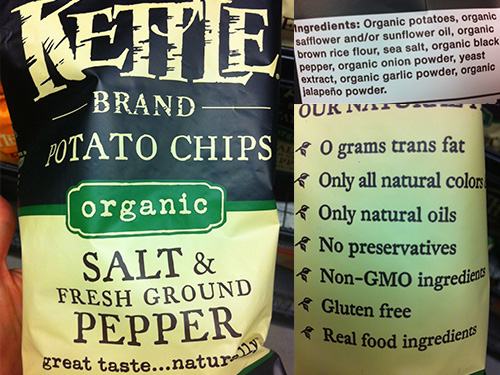
Rule #1: Never believe what you read on the front of a package
Oh, the beloved Kettle Chip. The only good thing I can say about Kettle is that there are very savy with their packaging. So many organic non-GMO bells and whistles! But it doesn’t stop me from seeing the offenders: Yeast Extract, Garlic Powder, and Jalapeno Powder. Why not use real garlic and jalapeno? Because the powders can legally hide MSG and they do not have to disclose that on the labeling. Maybe they are ‘safe’ because they are organic, but the Yeast Extract is a big NO-NO. That is always MSG in disguise.
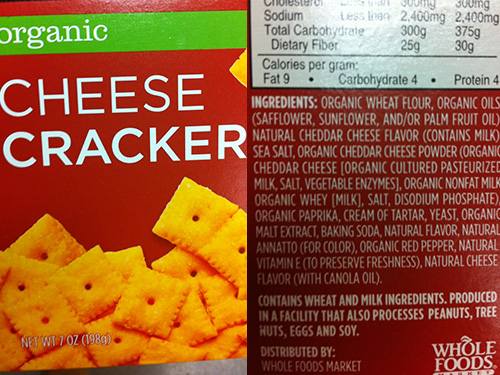
Learn to know what ingredients to avoid
Another example of a tainted organic food. This is the WholeFoods brand, and from what I’ve gathered, they seem to hide their MSG under the term ‘Natural Flavor.’ Yes, legally that can have MSG in it. It is an easy way to hide MSG in food. And since WholeFoods claims that their brand is MSG-free, they don’t seem to want to use the classic Yeast Extract ingredient. Any time I see ‘Natural Flavors,’ I do NOT buy. This product also has ‘Malt Extract’ and ‘Annatto,’ two other forms of MSG in disguise.
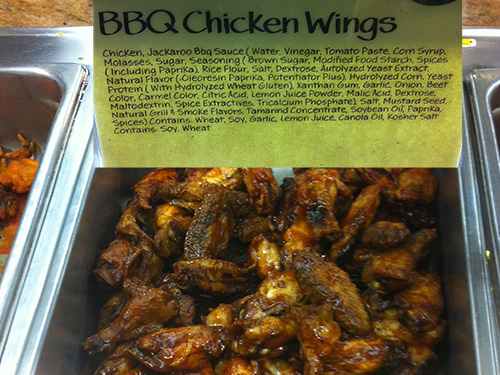
There is no such thing as a healthy BBQ chicken wing.
I really have no idea who would go to WholeFoods to buy BBQ Chicken Wings, but who are we kidding here? This is NOT a healthy version! Note the ‘Spice Extractives,’ ‘Natural Grill and Smoke Flavor,’ ‘Spices,’ ‘Yeast Extract,’ ‘Natural Flavor,’ ‘Yeast Protein.’ I think I’m going to be sick.
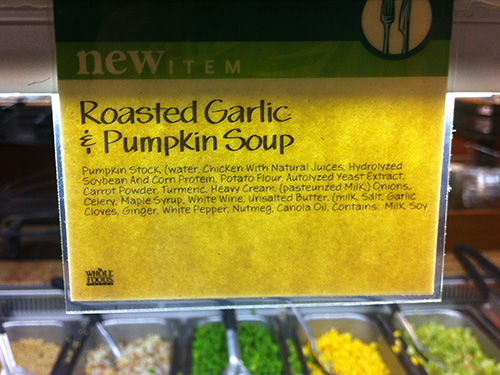
Be wary of all soups in restaurants and salad bars, 99% of them have MSG in the soup stock.
Seems like a good idea…a nice warm filling soup. but read that label! ‘Soybean and Corn Protein,’ Yeast Extract,’ ‘Carrot Powder,’ ‘Pumpkin Stock.’ All MSG in disguise.
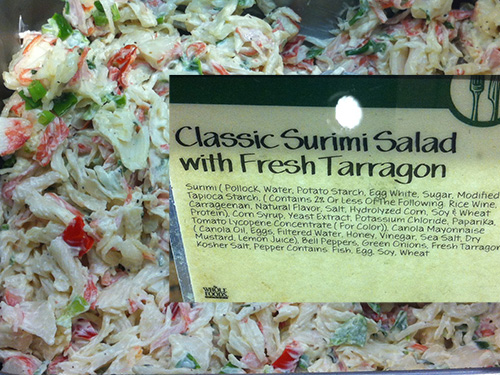
This salad just looks plain scary to me.
Nothing is sacred anymore. They even managed to ruin this dish by adding ‘Natural Flavor,’ ‘Soy and Wheat Protein,’ ‘Yeast Extract.’ You must start reading labels and if you see these ingredients, do not eat!
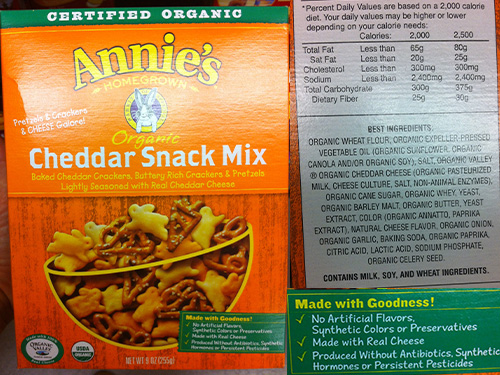
Organic food can still be tainted with flavor enhancers. Learn to discriminate!
Oh, the food industry is so good at food label trickery! Made with Goodness! Doesn’t fool me. Read ‘Yeast Extract,’ ‘Natural Cheese Flavor,’ ‘Paprika Extract’ and suddenly this so-called healthy organic food is no longer an edible item in my book. Yes, they can legally use this ingredients with hidden additives, and since they did not add anything themselves, they can label their product with ‘No Artificial Flavors.’ Never believe the marketing schtick on the front or side of a box. Always check the ingredients.
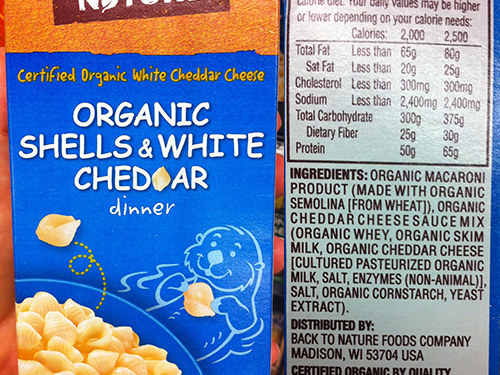
Again, ‘organic’ does not guarantee no added flavor enhancers
Think you’re doing your children a favor by buying organic Mac and Cheese? Does it still take 2 hours for them to calm down and sleep at night and are they cranky, irritable and fighting all evening? It’s probably from the MSG in disguise: ‘Yeast Extract.’ Kids go bonkers when they eat MSG. Their bodies are much smaller than an adult. Take out MSG and you will have a happy, well behaved child that sleeps through the night. For breast-feeding moms, the MSG is passed through your breastmilk, so if your baby is colicky and doesn’t sleep, try eliminating all MSG foods. You’ll be amazed.
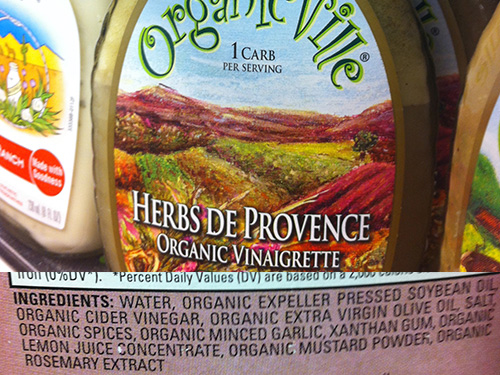
Still not sure about ‘Rosemary Extract’
All I can really say about this one is: Watch this space. I saw A LOT of ‘Rosemary Extract’ in foods at Wholefoods and Fresh Market, and I have not seen it used so much before. It wouldn’t surprise me if the food industry is reinventing MSG once again now that we are onto the whole Yeast Extract, Spices and Natural Flavors thing. Anytime you see a vegetable with the word ‘extract’ after it, be very suspicious (unless it is Vanilla Extract, which is ok because it is not a salty deritive). I will personally avoid all foods with ‘Rosemary Extract’ until someone starts doing some explaining.

Beware of ‘clean and green’ looking products
Looks so healthy, proclaiming to ‘eat your vegetables.’ You should be an expert by now: ‘Natural Flavor,’ ‘Onion Powder,’ ‘Garlic Powder.’ Other flavors of this brand also have ‘Yeast Extract.’ Note this is Sea Salt flavor!

Don’t think bulk foods are food additive safe – still read the ingredients!
Bulk does not make a healthier option. You have to read all labels, always and forever. Here we have ‘Corn and Soy Protein,’ ‘Natural Smoke Flavor,’ ‘Yeast Extract,’ ‘Natural Flavor.’ Ever wonder why these ingredients are always in salty, savory foods and not in sweets and cakes? Because MSG is a salty, savory flavor enhancer. It makes salty foods taste even more savory and it is chemically addictive. This bulk snack mix is from Fresh Market.

Always check the ingredients, even if you think the food ‘should’ be ok!
An obvious offender: Monosodium Glutamate, or MSG. This photo was taken at Fresh Market (a correction to my November 2012 newsletter).
So what do I buy at WholeFoods?
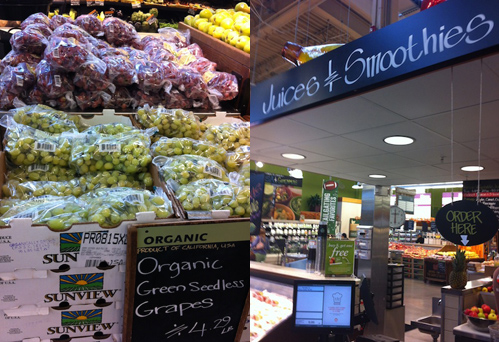
I love fresh juice and smoothie bars, and fruit, aka REAL FOOD!
If the WholeFoods has a juice and smoothie bar, I’m so there! I also buy fresh fruits and veggies, preferably organic and on sale.
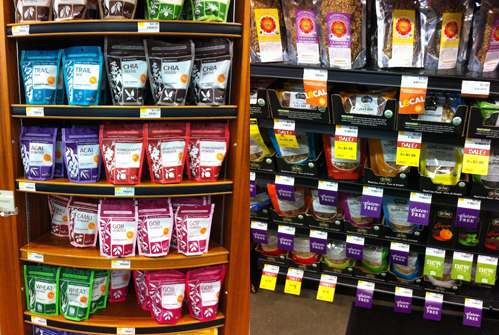
Choose 100% Certified Organic Superfoods to avoid any added fillers
I like to check out the 100% raw and organic Superfood section.

There are some healthy raw food options at WholeFoods
I look for organic flax and hemp seeds, bulk organic raw pumpkin seeds or sunflower seeds, raw apple cider vinegar and a raw granola, as a treat.
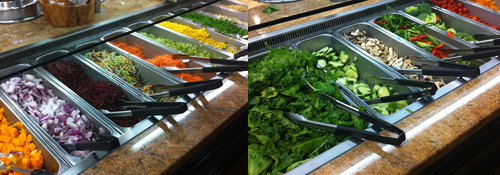
Stick to fresh raw vegetables with no added dressings or sauces
At the Salad Bar, I choose RAW FRESH VEGGIES only. I do NOT trust the pre-made salads or the pre-made salad dressings. I use olive oil, apple cider vinegar or fresh lemon juice as a dressing.
A quick lesson on Monosodium Glutamate:
Monosodium Glutamate is a flavor enhancer and an excito-toxin, also known as MSG. It can be listed on a food ingredient label as 621 or E621 (these are universal numbers used everywhere in the world). MSG is known to overstimulate the flavor in food, making it taste better. The problem is that it also overstimulates the brain (making it an excito-toxin). For some, the reaction can be headaches, sensitivity to light and sound (especially in children), insomnia or restless sleep, anxiety, irritability, vertigo, dizziness and even depression.
Because a lot of consumers are aware of the dangers of MSG, the food industry has invented new ways to hide MSG in food, the main way being to ‘hide’ it in another ingredient. This keeps the cost of production low (using cheap flavor enhancers to create a tasty food), and still makes the food very marketable, appearing food additive-free by promoting non GMO, organic or ‘all natural’.
The result: more consumers buy and that means more profit.
The other additives which are similar to MSG are Ribonucleotide (635), Disodium Inosinate (631) and Disodium Guanylate (627). These 3 flavor enhancers are what I call the ‘New MSG’ because they are being used more and more to give that same ‘salty savory tasty excito-toxin additive yumminess’ to a food, but the food can be labeled as ‘MSG Free’ or ‘No Added MSG.’ These flavor enhancers tend to react with people in a slightly different way: in men, they can raise uric acid levels resulting in early symptoms of gout, and in women: an itchy intolerable rash. Men can also experience the ‘ribo rash’ too but in my experience, the rash is more common in women.
So what’s the bad news?
The bad news is that ALL 4 of these flavor enhancers can be legally hidden under 50 other names. The most common ones I see, especially in ‘so-called’ healthy food are: Yeast Extract, Pea Protein, Spices, Natural Flavors, Smoke Flavor, Malt Extract, Annatto, Soy Protein, Wheat Protein, Corn Protein, and Yeast Protein. I have reacted to Onion Powder, Vinegar Powder and Garlic Powder enough times to add them to my personal list of ‘DO NOT EAT’ as well. For a complete list of hidden names for MSG or high factory created glutamate ingredients, go to msgmyth.com.
If you think you have reacted to a food which is either not labeled correctly or is label suspiciously, you have every right to contact the company by email and ask what’s in their food.
You can do this in every country in the world, even as an ex-pat living in a foreign country. I suggest that you word your email in this way:
“I recently ate your xyz product and x hours later I experienced the following reaction: (describe symptoms here). I have discussed this with my doctor and he/she has informed me that I need to know for medical reasons all of the ingredients that was in the food. Specifically, I need to know if you use MSG (Monosodium Glutamate), Ribonucleotide, Disodium Inosinate or Disodium Guanylate in any of the ingredients that you use to make your product. Also, I need to know how much factory created free glutamate is in the following ingredients (list suspicious ingredients like pea protein, yeast extract, malodextrin, soy protein, natural flavorings, etc here). Thank you and I appreciate you taking the time to respond to my inquiry.”
I do NOT suggest that you write any emails like this: “Jennifer said blah blah blah blah and Jennifer’s blog post says blah blah blah so what do you have to say about that?!” Please, be professional and courteous if you are writing an inquiry to a company. You have to ask the right questions to get the right answers. These companies have legal teams that know how to respond and get through hoops if you do not ask the right questions. My goal is that every product be required to label their total factory created glutamate concentration and any hidden ingredients or flavor enhancers so ultimately, you can make the best choice of food for you!


I’ll be writing more blog posts about this in the future, so be sure to sign up to my RSS feed!
For more on how to start an additive-free diet diet, how to manage food allergies or what minerals you may specifically be deficient in, book a private health consult with me via Skype.
How to Book Your Health & Nutritional Coaching Session:
1. Take photos of your eyes with a digital camera.
2. Email the photos to me for approval.
3. We schedule a time to meet via phone or Skype!
More on Food Additives: